About AutoPLI

Overview
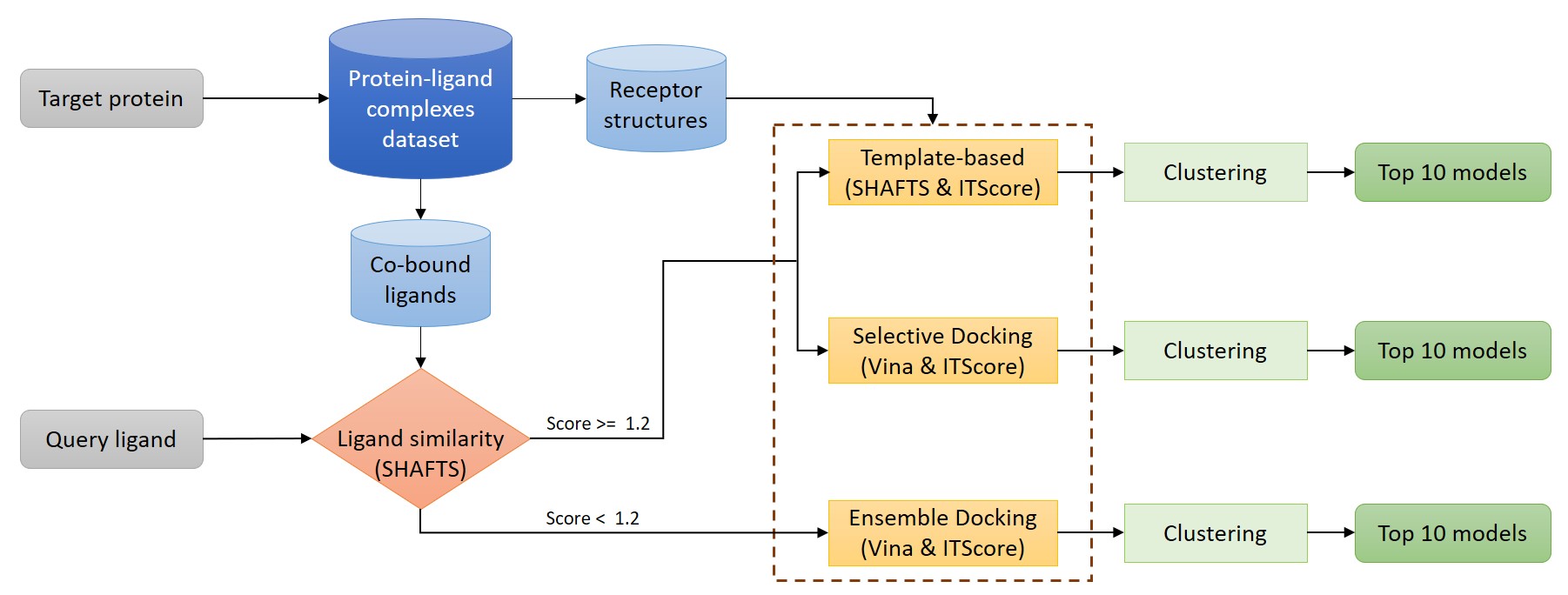
The AutoPLI web server is designed to fully automatically predict protein-ligand interactions. Specifically, the user only needs to provide a query ligand structure and the UniProt ID of a target protein. The server will collect all available protein-ligand complex structures for the target protein from current Protein Data Bank. Then, both template-based and docking-based methods are performed to predict the query ligand-protein complex structures based on known protein-ligand complex structures. The following figure shows a flowchart of the prediction strategy used in the AutoPLI server.


Methodologies
The followng procedures will be performed by AutoPLI according to inputs from the user:

1. Building protein-ligand complexes dataset

For a given UniProt ID, all PDB structures (X-ray or NMR) of the protein listed in the UniProt database are downloaded from the Protein Data Bank. All co-bound ligands are identified using pre-defined criteria (such as molecular weight and relative buried surface rate). Then, a dataset containing protein-ligand complex structures for the target protein is constructed.


2. Predictions based on known protein-ligand complexes

A hybrid strategy integrating both ligand-based and receptor-based methods is employed in this step for predicting protein-ligand interactions. First, the molecular 3D similarities of a query ligand with respect to co-bound ligands in the protein-ligand complex structures available are calculated using the program SHAFTS. The similarity score values range between 0 and 2, in which 0 represents no similarity and 2 indicates identical ligands.
The following two processes are performed dependents on the highest similarity socre of the query ligand with co-bound ligand in known protein-ligand complexes.

2.1 If any co-bound ligands with similarity score >= 1.2 are found

The following two parallel steps will be performed:
(a) Template-based method: The query ligand is superimposed onto the co-bound ligands using SHAFTS. Then, the protein-query ligand complexes are evaluated and ranked using an in-house protein-ligand scoring function, ITScore.
(b) Selective docking: The protein structure with a co-bound ligand sharing the highest similarity with the query ligand will be selected for docking. A modified AutoDock Vina (setting maximum output number to 500) is used for sampling, and ITScore is used for ranking. For both steps, the ranked models are then clustered in terms of Lrmsd. Finally, top 10 ranked binding modes (viewable online) are reported separately for each step.

2.2 If all the co-bound ligands have similarity scores < 1.2

An ensemble docking (using multiple protein conformations) will be performed by Vina. The binding modes generated from different protein conformations will be merged and evaluated using ITScore, followed by the clustering step. The top 10 binding modes will be reported and are viewable online.


3. Regular docking service

AutoPLI also provides a regular docking service. If a user provides a protein structure in PDB format, the server will dock the query ligand to either the whole protein surface or the specified binding pocket (if the binding site location is provided). Vina is used for sampling and ITScore is used for ranking. The top 10 models will be reported and are viewable.


References:
  1. Xu X, Duan R, Ma Z, Zou X. AutoPLI: A Fully Automated Server for Predicting Protein-ligand Interactions. (submitting)
  2. Xu X, Yan C, Zou X. Improving binding mode and binding affinity predictions of docking by ligand-based search of protein conformations: evaluation in D3R grand challenge 2015. Journal of Computer-Aided Molecular Design, 31: 689-699, 2017. [link]
  3. Duan R, Xu X, Zou X. Lessons learned from participating in D3R 2016 Grand Challenge 2: compounds targeting the farnesoid X receptor. Journal of Computer-Aided Molecular Design, 2017 (In Press). [link]